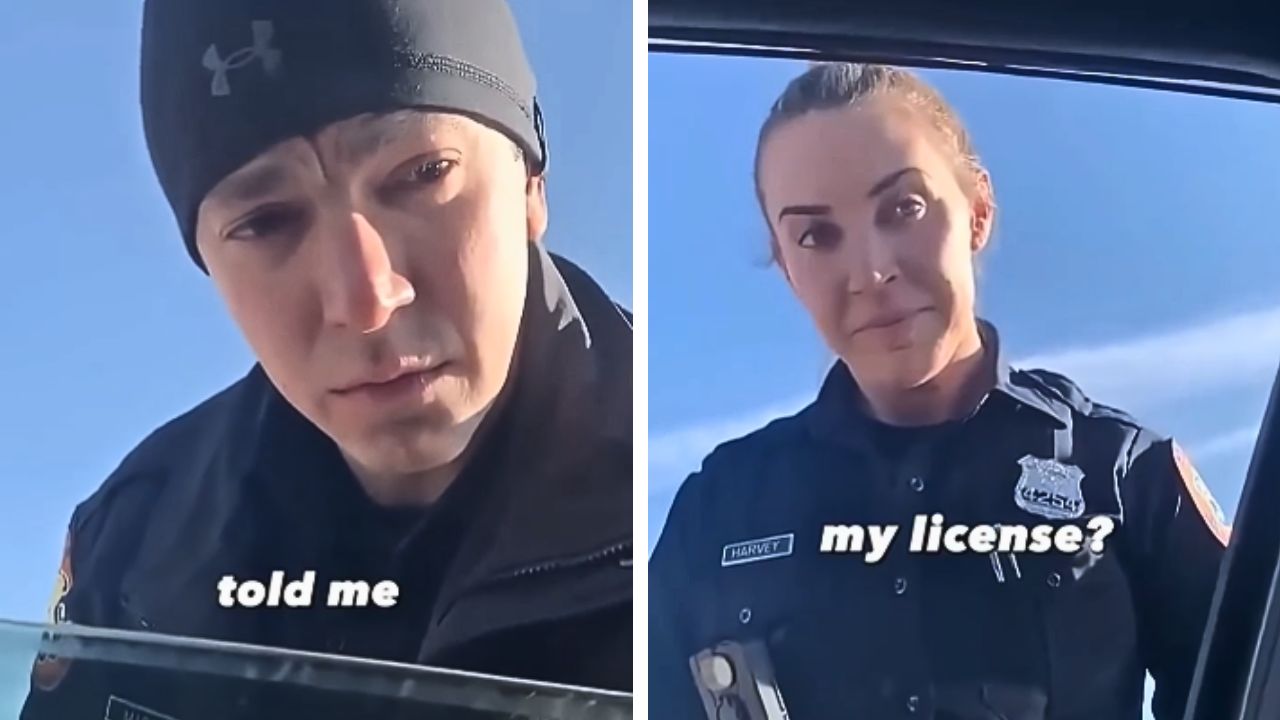
A video shared by @musktylerey is circulating on X and has people asking whether police officers can require passengers to identify themselves during a routine traffic stop. The clip, which has 205,000 views as of publication, shows a passenger refusing to hand over his identification after a vehicle was stopped for allegedly having tinted windows.
In the video, an officer asks the passenger for both his ID and driver's license. The passenger repeatedly questions why he needs to provide identification when he is not the one driving the vehicle. "So I'm the passenger in the vehicle, and you're asking for my license?" he asks.
After the officer says she needs to "check something," he refuses and says, "I'm not the driver, so I'm confused."
Passenger during a traffic stop: “I’m not the driver, why do you need my ID?”
— Viral Courtroom (@musktylerey) August 6, 2026
Officer can ask. Passenger can refuse without reasonable suspicion specific to them.
Supreme Court precedent covers this. pic.twitter.com/tTLobFcPU5
Later in the video, a legal content creator states that passengers generally cannot be compelled to identify themselves unless officers have reasonable suspicion or probable cause that the passenger committed a crime. The narrator cites several U.S. Supreme Court decisions; while officers may ask for identification, they cannot necessarily require it.
On X, users debated the legality of the stop and whether passengers should cooperate with police regardless of their legal obligations. One wrote, "As a PASSENGER on a traffic stop… They can make you step out but no ID without probable cause." Another recalled how they challenged a similar request after asking for a supervisor, while a third said that police checking identification helps remove "felons off our streets."
Others said that state laws can differ. One said that Ohio recently allowed officers to identify everyone inside a stopped vehicle.
Of course that’s correct unless he were to initiate himself into a situation regarding a crime pertaining from the stop. He didn’t. She can ask but the answer is absolutely no!
— Alan (@Alan00190000) August 6, 2026
But in the 2007 case of Brendlin v. California, the U.S. Supreme Court held that traffic stops are Fourth Amendment-protected seizures of both drivers and passengers. The ruling established that passengers, like drivers, are seized within the meaning of the Fourth Amendment during a traffic stop.
In Rodriguez v. United States (2015), the Supreme Court held that officers may not extend a traffic stop beyond the time needed to complete its mission without reasonable suspicion of criminal activity. Another frequently referenced case is Hiibel v. Sixth Judicial District Court of Nevada (2004), in which the Supreme Court affirmed Nevada's "stop-and-identify" law. But only when police have a valid reason to make an investigative stop does the decision become relevant.
The Daily Dot was unable to independently verify the identity of the passenger in the video or the specific details of the traffic stop. The Ohio state law claim cited by a commenter was not independently verified. The legal information provided in this article is for informational purposes only and does not constitute legal advice. Readers should consult a licensed attorney for guidance on their specific circumstances.