For many disabled people, the Internet offers a unique opportunity to communicate with others. If going out is too tiring or painful, or if meetup venues are inaccessible, people who are disabled or who have chronic illnesses can quickly find others in a similar situation on social media.
Recently, in addition to blogging, tweeting, pinning, etc., there has been a growing number of disabled vloggers putting themselves out into the world. They share details of their lives, answer viewers’ questions, and demonstrate their specialist knowledge and interests through their YouTube channels.
And thousands of people are watching along.
1) Kelly Patricia
Kelly Patricia is a vlogger who talks about her life with chronic illness. Her complex health issues provide her with a range of topics to discuss, from raising awareness of Inflammatory Bowel Disease to discussing the best kind of clothing to wear when you are bloated. Her YouTube playlist also includes humor, including a suitably sarcastic video on things doctors say when they don’t know what’s wrong.
The frustrations Patricia feels at her treatment by some medical professionals and the difficulty in finding the correct diagnoses to address her health problems come through in several of her videos, reflecting the reality that many disabled and chronically ill people face when trying to be taken seriously. She has an amiable manner and relaxed presentation style, and the comments left on her videos demonstrate the supportive community she has created in her online world.
2) Mindy Tucker
Mindy Tucker, a university student from Winnipeg, Canada, vlogs on the channel Living My CP Life. In her videos, she talks about life with cerebral palsy (CP) and vision issues, covering everything from botox as a treatment for CP to dating, bowling, and bagels.
When talking about why she started her YouTube channel, Tucker says, "I want to become a voice for people with CP who have questions," and, throughout her body of work, she combines her own personal experience with helpful advice for others, presented in an upbeat, engaging way.
In “Advocating for Yourself With a Disability,” for example, Mindy offers suggestions on how to get the best out of medical appointments and tips for making sure you stand up for yourself in these potentially stressful situations.
She discusses situations familiar to many disabled people, such as being “talked over” by doctors, and she reinforces the fact that “You know your body better than anybody,” empowering viewers to take control of their own conversations with medical professionals.
3) Marty Ferguson
Marty Ferguson is also a Canadian with cerebral palsy, and he vlogs on his YouTube channel Misterwheelz86. In an explanatory video, “My Story,” Ferguson explains his situation, insisting that "This video is not a sob story. I am not here to make people feel sorry for me."
Ferguson hopes to inspire his viewers, talking of carrying the Olympic torch and raising money for charity. However, the vast majority of his videos are not about disability; they are about sport.
An avid sports fan, Ferguson has an archive of dozens of sports commentaries on his YouTube channel, interspersed with food and drink reviews. One of his most recent offerings covered the Super Bowl, focusing on the final quarter of the game.
4) Emily Davison
Like Ferguson, Emily Davison is a disabled blogger whose videos focus on other topics. Known on YouTube as fashioneyesta, Davison aims “to bridge the gap between fashion and accessibility making fashion and cosmetics a more inclusive place for anyone and everyone!”
Immediately challenging the idea that somebody with a visual impairment couldn’t possibly understand beauty, clothes, and makeup, the video introducing Emily’s channel presents a world where fashion is a multi-sensory experience.
The London-based vlogger’s passion for clothes, trends, beauty, and cosmetics is infectious as she reviews fashion shows, excitedly shares her own purchases and, more and more, links her hobbies to her eye condition—septo-optic dysplasia—with videos about how to apply makeup with sight loss and personal insights into living with a pituitary condition.
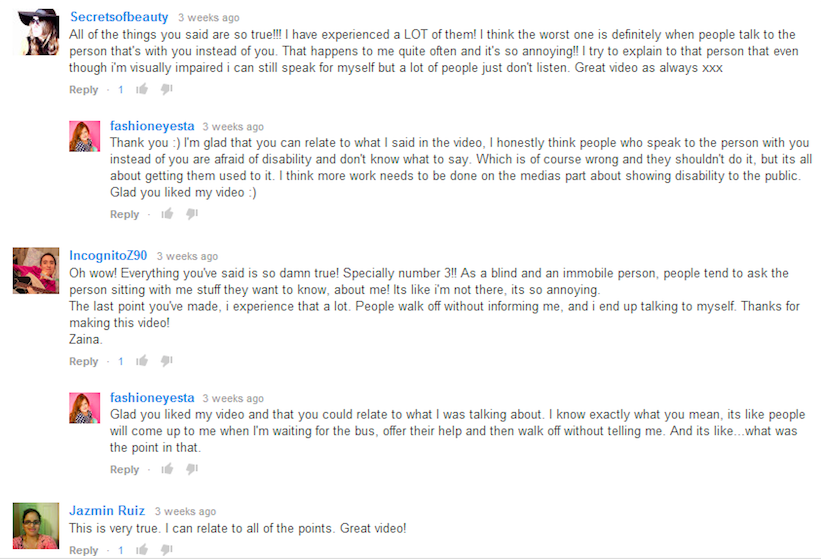
Davison’s videos are energetic and funny, and the comments often show that her viewers find her, and her video content, highly relatable. When she shared a list of “things you should never say to a visually impaired person,” commenters enthusiastically agreed.
Philippa Willitts
5) Tommy Edison
Tommy Edison’s YouTube channel, The Tommy Edison Experience, showcases a hilarious vlogger with an irreverent take on being blind in a sighted world.
Whether he’s trying to guess the color of scented markers or explain the intangibility of a horizon, Edison is entertaining, and it’s easy to get sucked into watching him semi-patiently answering relentless viewer questions that range from the sublime to the ridiculous.
But Tommy doesn’t only talk about blindness and his experiences; he also runs a channel called the Blind Film Critic. When reviewing movies, he uses his characteristic humor to critique the films he’s seen, giving sighted viewers an insight into the experience of consuming films without the visual element.
His review of Fight Club is enthusiastic and witty—“strong story, fantastic performances; this movie’s great all the way round”—describing not just the actors’ performances and the soundtrack but also praising it for not making the visuals “terribly critical to the story.”
(He was less enamored with Man on a Ledge: “By the time what’s supposed to happen happens, you just don’t care.”)
So, while some disabled and ill vloggers, such as Mindy Tucker and Kelly Patricia, create videos about their impairments or personal lives, for others, like Marty Ferguson, disability is incidental to the majority of their shows. Emily Davison and Tommy Edison sit somewhere in the middle; both reference their loss of sight where it’s relevant and, in doing so, they open up non-disabled viewers’ understanding and provide witty, relatable material for their visually impaired fans.
Whether talking directly about disability or not, these and other disabled and ill vloggers demonstrate that online tools to manage video recording, editing, and streaming are becoming more accessible. Their participation in the YouTube community increases the online visibility of disabled people, hopefully encouraging others to find a way to express themselves and share their lives on the Web using a new, emerging medium.
Photo via DAVID BURILLO/Flickr (CC BY 2.0) | Remix by Jason Reed