A viral video shared on X is drawing attention after appearing to show baby carrots being repackaged at an Amish market. The post also claims that baby carrots aren't grown as miniature carrots but are machine-cut from larger carrots.
Many Amish markets pride themselves on selling locally sourced produce, which attracts many of their customers. But some viewers say the video has caused them to question whether certain products are being repackaged before they're sold.
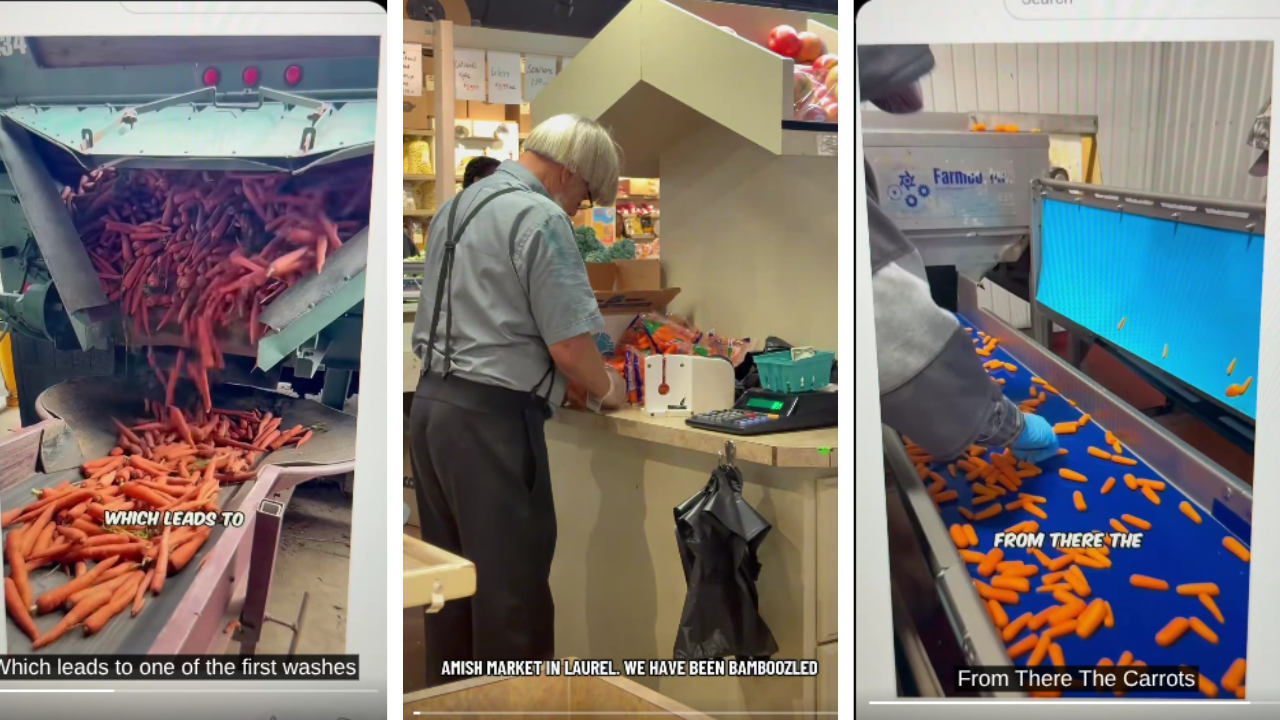
Employees are seen dumping grocery store packs of baby carrots into different bags to be sold at the Amish Market in Laurel, Maryland
— Wall Street Apes (@WallStreetApes) July 6, 2026
The exact location is the Dutch Country Farmer's Market. This may be because baby carrots are made by machine cutting full size carrots into… pic.twitter.com/Eof6GRfrvC
The video, reshared by @WallStreetApes, now has close to 500,000 views, and almost everyone who commented is shocked and disappointed by the dishonesty of the people in charge of this scam operation in the Amish community. As per the post, it highlights the Amish Market in Laurel, Maryland, specifically named the Dutch Country Farmer's Market.
The video begins with someone secretly recording an Amish worker at the Dutch Country Farmer's Market who can be clearly seen dumping a different grocery store-style brand of packaged "baby carrots" into another unbranded bag, then re-sealed. The repackaged version is then marketed as a locally sourced Amish item, and clients pay top dollar for the illusion.
One X user commented, "I'm not against if they are up front and open about the source. They need to make a living too. Many booths at farmer's markets sell the same produce you buy at supermarkets. Mostly they hide that fact and want people to believe they grew it themselves."
Would You Still Trust Amish Products After Knowing of this Amish Baby Carrots Scam?
The X video went on to include a clip of another farmer showing the process in which baby carrots are made. So, before baby carrots are "made," they're harvested as regular-sized carrots. Once harvested, the carrots are loaded into the back of a truck and taken to a manufacturing plant where they're offloaded onto a conveyor belt and washed.
After that, the carrots are dropped into a rinse tub, then lifted onto a barrel washed and scrubbed clean from any dirt residue. The carrots then go through a grading system where they are separated according to size. Carrots that are big enough to pass as "regular-sized" are packaged into three-pound bags.
The undersized carrots are placed into a carton and taken through another machine process where they are made into baby carrots. The machine chops the carrot up until they are "baby carrot size." They go through another barrel that further separates the much smaller chops from the "perfect" baby carrot-sized cuts. Finally, they are hand-graded individually and packed into two-pound bags and sent to a grocery store near you!
This is the point where they are usually selected by Amish market farmers, repackaged to appear as Amish-grown vegetables, and resold to oblivious customers.
One individual on X wrote, "The Amish repackage items nobody believes the Amish harvested the carrots. An Amish store in Fountain City, IN does the same thing with candy. Nobody believes it’s Amish candy." So, allegedly, they do the same thing with multiple items.
One commenter defended the Amish farmers, stating that not everyone who appears Amish is truly Amish, "NEVER buy Amish products from NON AMISH people. True Amish have markets around where they live and sell their products themselves on certain days and it's some of the best stuff you'll ever get!"
This X user gave a warning about a forgotten part of the process that allegedly goes into making baby carrots, "The B vitamins are on the skin. Don’t peel carrots and never eat baby carrots. They are coated with Stay-White which is basically bleach. Same with pre-made salad in a bag."
The Daily Dot reached out to Dutch Country Farmers Market for comment. The Daily Dot was unable to independently verify the claims made in the video.